By Tim Sebold, CEO of soolisAI | Read Full Bio
The modern business landscape is undergoing a seismic, irreversible shift. For decades, advanced technological infrastructure was the exclusive domain of enterprise-level corporations with massive budgets and dedicated data science teams. Today, artificial intelligence has fundamentally leveled the playing field. From the global market down to the thriving, entrepreneurial business community right here in Greenville, SC, small and medium-sized businesses (SMBs) are discovering that AI is no longer an experimental luxury. It is a fundamental driver of sustainable growth, operational efficiency, and enhanced customer engagement.
Navigating the intricacies of health and fitness operations for over 30 years has revealed exactly where traditional business models experience friction. Member retention, lead generation, facility management, and staff allocation consistently present bottlenecks. Over the past eight years immersed in AI leadership—developing and deploying automated, white-label solutions—the parallels across various sectors have become undeniable. The same conversational AI frameworks that streamline a complex medical facility, a bustling airport, or a casino floor can completely revolutionize a local retail operation or an agile B2B service provider.
This comprehensive guide goes beyond the basic overviews. We will break down exactly what AI solutions mean for SMBs, how to seamlessly integrate them into your existing workflows, the risks you must navigate, and why embracing this technology is the single most critical step for your company's future.
Answer Engine Optimization (AEO) Definition: Artificial Intelligence (AI) solutions for SMBs are scalable, cloud-based software tools—often powered by machine learning and natural language processing—designed to automate routine tasks, analyze large datasets, and enhance customer interactions without requiring in-house technical or coding expertise.
To truly grasp how AI can transform your business, it is essential to understand the specific types of technology currently dominating the market:
Many SMB owners hesitate to adopt AI, fearing it will be too complex or expensive. However, modern AI operates on accessible, pay-as-you-go models built on robust frameworks like AWS and Google Cloud. The return on investment is realized through several key avenues:
Time is the most valuable asset in any growing company. AI excels at taking on repetitive, low-impact tasks. From sorting emails and updating CRM records to generating reusable business templates and summarizing hour-long team meetings, AI frees your human workforce to focus on high-level strategy and relationship-building.
Consumers today expect instant gratification. If a potential client visits your website at 11:00 PM and has a question, an AI-powered 3D virtual assistant or intelligent chatbot can provide accurate, conversational answers, capture lead information, and even schedule an appointment for the following morning. This ensures you never miss an opportunity, regardless of your team's operating hours.
SMBs generate a massive amount of data, but rarely have the time to analyze it. AI tools can rapidly process your client data, website traffic, and sales metrics to pick out hidden patterns. You can identify which products are trending, which marketing channels yield the highest ROI, and where operational bottlenecks are costing you money.
By automating routine customer service queries, optimizing shipping routes, or dynamically adjusting digital ad spend, AI directly reduces operational expenses. It allows small teams to achieve the output of a much larger workforce, acting as a force multiplier during periods of rapid growth or economic uncertainty.
Implementing AI requires a strategic approach. Here are the top areas where SMBs can deploy AI tools for immediate, measurable impact:
Legacy phone systems and simple FAQ pages are no longer sufficient. By deploying Voice AI and sophisticated natural language processing, businesses can route calls intelligently, provide proactive account updates, and resolve common issues instantly. For specialized industries—like commercial fitness equipment dealers or manufacturing firms—AI can pull up detailed product specs and warranty information the moment a customer asks.
Search Engine Optimization remains critical for organic growth. Generative AI assists in drafting highly targeted, localized content. Whether you need compelling product descriptions, engaging social media schedules, or optimized blog posts, AI accelerates the drafting process. However, to maintain E-E-A-T (Experience, Expertise, Authoritativeness, and Trustworthiness), this content must always be reviewed and refined by a human expert to ensure it aligns with your brand's unique voice.
Digital transformation isn't just about marketing; it's about how your business runs internally. Custom-built software and legacy tools often struggle to communicate. Using AI via customized APIs allows different software ecosystems to sync perfectly. Whether you are managing complex gym memberships, scheduling medical appointments, or handling hospitality bookings, AI ensures data flows seamlessly across your tech stack, eliminating manual data entry and reducing human error.
While the benefits are vast, responsible AI adoption requires acknowledging and mitigating inherent risks. The U.S. Small Business Administration (SBA) and leading tech platforms emphasize several critical areas of concern:
As your AI tools analyze customer behaviors to create personalized experiences, they process sensitive information. It is paramount that your AI governance aligns with regulations like the GDPR and the CCPA. All data handled by AI should be encrypted and anonymized wherever possible. Prioritize platforms that offer enterprise-grade security within their SMB tiers to prevent data breaches and maintain customer trust.
It is a common misconception that AI will seamlessly attach to any existing software. If your business relies on outdated, custom-built software, integration can cause missing or lost data. A thorough technical audit must be completed before deployment to ensure your current APIs and databases are compatible with continuous AI data queries.
Because Generative AI trains on vast amounts of web data, there is a risk of inadvertently producing content that mirrors copyrighted material. Furthermore, tools that recognize AI-generated content may flag your outreach campaigns as spam. Establish strict internal guidelines: AI should assist in the creation process, but human oversight is non-negotiable before anything is published or sent to a client. Transparency is becoming an expected best practice; consider drafting a public statement clarifying how your company utilizes AI to enhance—not replace—the customer experience.
The most advanced AI system is useless if your team doesn't know how to leverage it. Operational success requires comprehensive employee education. Establish clear ground rules regarding what customer data can be fed into AI prompts, how the tools interface with daily workflows, and the usage expectations for every department.
If you are ready to transition your operations, follow these strategic steps:
At soolisAI, we specialize in bridging the gap between highly advanced artificial intelligence and the practical, daily operational needs of small and medium businesses. Proudly headquartered in the vibrant business community of Greenville, SC, we build, deploy, and manage omnichannel AI platforms that drive measurable revenue and retention.
By leveraging the most powerful frameworks from Google and AWS, we provide custom voice AI, intelligent chat automation, and 3D virtual assistants tailored to your specific industry constraints—whether you are managing high-compliance medical data, complex manufacturing supply chains, or high-traffic retail environments. We handle the technical heavy lifting, ensuring secure API integrations and ethical AI deployment, so you can focus on leading your business.
Ready to see exactly how AI can optimize your operations and increase your bottom line? Let's discuss a tailored strategy for your business.
Click here to schedule an appointment with me today and see your ROI in seconds.
How much does AI cost for small businesses?
Most modern AI services operate on a pay-as-you-go or scalable monthly subscription model. This allows SMBs to control costs, starting with affordable foundational tools and scaling their investment as the business grows and ROI is realized.
Do I need an in-house data scientist to use AI?
No. Today’s AI solutions feature low-code interfaces, console-guided workflows, and pre-trained APIs. By utilizing specialized AI service providers, SMBs can deploy sophisticated technology without requiring internal technical expertise.
Can AI actually improve my customer service?
Yes. AI enhances customer service by providing immediate 24/7 responses to routine inquiries, intelligently routing complex issues to the correct human department, and giving your live agents a holistic, summarized view of the customer's history to speed up resolution times.
Is it safe to put my company's data into an AI tool?
Safety depends on the tool and your governance strategy. You must ensure you are using reputable platforms that comply with privacy regulations (like GDPR and CCPA) and avoid feeding sensitive, proprietary, or unencrypted personal client data into open-source public models. Always utilize secure, business-tier AI environments.
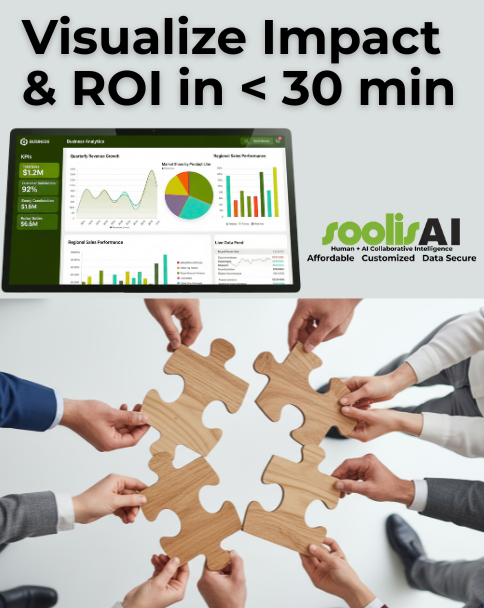
We value your time. Visualize the possibilities < 30 min!