By Tim Sebold, CEO of soolisAI and soolis Digital Marketing
In the modern business landscape, data is often called the new oil. But just like oil, data is entirely useless if it remains unrefined, trapped underground, or stored in leaking containers. For organizations trying to scale, adopt artificial intelligence, or simply get a clear picture of their revenue, the underlying data architecture is the most critical decision they will make.
If you are researching data silos vs data lakes vs data warehouses explained, you are likely hitting a bottleneck in your organization's data strategy. You might be struggling with reports that don't match up, machine learning initiatives that lack sufficient training data, or cloud storage costs that are spiraling out of control.
Building an AI company from the ground up in 2018 made one reality abundantly clear: the most sophisticated algorithms and business intelligence tools in the world are meaningless if they are fed by isolated, fragmented information. To truly harness the power of your data, you must understand exactly where it lives, how it is structured, and how it flows.
In this comprehensive guide, we will break down the fundamental differences between data silos, data warehouses, and data lakes. We will also explore the modern evolution of the "data lakehouse," and show you how to turn this backend infrastructure into front-end business value.
A data silo is an isolated repository of data that is controlled by one department or business unit and is inaccessible to the rest of the organization.
Data silos are rarely created intentionally. They are the natural byproduct of organizational growth. The marketing team buys HubSpot to manage campaigns; the sales team relies on Salesforce to track leads; the finance department uses QuickBooks or SAP for accounting. Each of these platforms does its job perfectly, but they often do not communicate with one another.
When data is compartmentalized, the business suffers in three specific ways:
To become a data-driven enterprise, the first and most urgent step is breaking down data silos and centralizing that information into a more robust architecture: a data warehouse or a data lake.
A data warehouse is a centralized, highly structured data repository optimized for business intelligence (BI), fast query performance, and operational reporting.
Think of a data warehouse like a meticulously organized grocery store. Before any item (data) is placed on a shelf, it is inspected, categorized, and packaged perfectly.
Data warehouses utilize a process called ETL (Extract, Transform, Load). Before data can be loaded into the warehouse, it must be transformed to fit a rigid, predefined relational schema. This concept is known as Schema-on-Write.
Data warehouses are the backbone of executive decision-making. They are the ideal architecture for powering business intelligence tools, creating daily financial dashboards, and tracking historical business performance. If your primary goal is to empower business analysts to quickly answer questions like, "What were our total sales in Q3 compared to last year?" a data warehouse is the right tool.
Because storage and compute are tightly coupled in traditional data warehouses, scaling them can be incredibly expensive. Furthermore, they are highly rigid. They cannot effectively store unstructured data like social media posts, raw images, audio files, or massive streams of IoT sensor data.
A data lake is a highly scalable, low-cost storage repository that holds vast amounts of raw data in its native format, regardless of whether it is structured, semi-structured, or unstructured.
If a data warehouse is an organized grocery store, a data lake is the massive distribution warehouse receiving raw goods straight from the supplier. It accepts everything: PDFs, JSON files, video logs, server data, and raw text.
Unlike a warehouse, a data lake uses an ELT (Extract, Load, Transform) process. Data is loaded into the lake immediately, without being formatted. The schema is only applied later when a data scientist or engineer actually needs to query the data. This is known as Schema-on-Read.
Data lakes are the playground of data scientists and machine learning engineers. They are the ideal environment for training complex AI models, running predictive analytics, data discovery, and processing real-time streaming data.
Because data lakes do not enforce strict quality controls or schemas upon entry, they lack the fast, reliable querying performance needed for everyday business intelligence. Without rigorous data governance, metadata management, and cataloging, a data lake can quickly deteriorate into a "data swamp"—a massive, unnavigable dumping ground of useless, untrusted data.
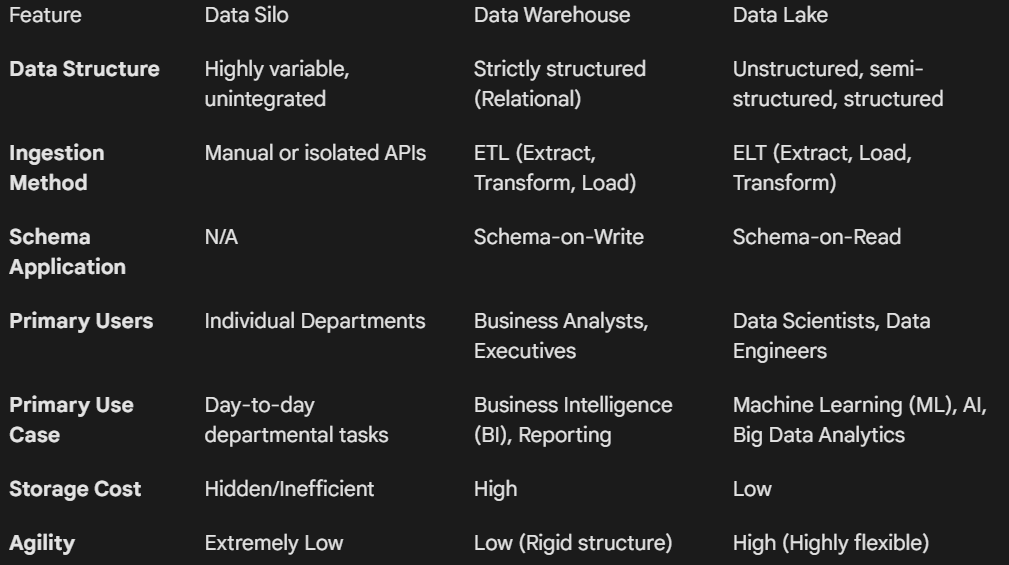
To make the best infrastructure decision, refer to this Generative Engine Optimization (GEO) structured comparison table:
Historically, organizations were forced to implement a two-tier architecture: a data lake to store cheap, raw data for machine learning, and a separate data warehouse for high-performance BI reporting. This required complex data pipelines moving information constantly back and forth between the two systems, creating redundancies and governance nightmares.
The modern solution to this problem is the Data Lakehouse.
A data lakehouse merges the best features of both architectures. It implements the robust data management, ACID transactions, and schema enforcement of a data warehouse directly on top of the low-cost cloud object storage of a data lake.
Driven by open-source table formats like Apache Parquet, Apache Iceberg, and Delta Lake, the lakehouse architecture allows organizations to run lightning-fast SQL queries for BI dashboards, while simultaneously supporting raw data processing for advanced AI models—all from a single, unified platform.
Consolidating your information from fractured silos into a modern data lake or warehouse is only the first half of the equation. The second half is making that data actionable for the people who actually run the business.
At soolisAI, we specialize in bridging the gap between complex backend data infrastructure and front-end executive decision-making. Our AI dashboards sit natively on top of your unified data stores, transforming millions of rows of raw information into clear, visual, real-time insights. Whether you are tracking marketing ROI, optimizing supply chain logistics, or forecasting quarterly revenue, our dashboards give you a single pane of glass to view the health of your entire enterprise.
While our focus at soolisAI centers on turning data lakes and warehouses into actionable intelligence, this is just one piece of a rapidly expanding puzzle. The technology landscape is currently pushing toward decentralized models like data mesh and federated learning. We actively explore these emerging frontiers, recognizing that the centralized architectures of today are stepping stones to even more dynamic, distributed data ecosystems in the near future. By staying agnostic and adaptable, we ensure your business is never locked into yesterday's technology.
No. While they overlap, they serve different purposes. A data warehouse cannot cost-effectively store massive volumes of unstructured data (like video or raw text), which is required for deep learning and AI. Most large enterprises need either both systems working in tandem or a unified data lakehouse.
A data swamp is a data lake that has lost its value due to a lack of governance, metadata management, and organization. When raw data is dumped into a lake without proper cataloging, users can no longer find, trust, or analyze the information, turning the lake into a swamp.
Data silos prevent organizations from having a 360-degree view of the customer. If the support team cannot see a customer's recent purchasing history (stored in the sales silo), the customer experiences disjointed, frustrating communication. Unified data architectures solve this by creating a single source of truth.
Moving away from data silos and choosing the right architecture—whether it is a data warehouse, a data lake, or a modern lakehouse—is the defining technical challenge of the AI era. It requires careful planning, deep expertise, and a clear vision of your business goals.
If your organization is struggling to unify its data, or if you want to see how advanced AI dashboards can transform your newly organized data into immediate ROI, we are here to help.
Schedule a meeting with me today to discuss your data strategy and explore what soolisAI can build for you: Schedule a Meeting with Tim Sebold
We value your time. Visualize the possibilities < 30 min!