The Definitive AI Business Case SMB Blueprint: How to Justify, Calculate, and Execute Small Business AI Investment
The Pragmatic SMB Imperative for Artificial Intelligence
Small and Medium Businesses (SMBs) operate in a macroeconomic environment characterized by persistent labor constraints, tightening margins, and intense competitive pressures. In this climate, Artificial Intelligence (AI) has shifted from an experimental luxury reserved for Fortune 500 enterprises to an existential operational layer for growing companies.
However, a dangerous disconnect has emerged. While enterprise conglomerates deploy multi-million dollar budgets to train proprietary Large Language Models (LLMs) and build bespoke machine learning infrastructure, SMBs are frequently left stranded between two extremes: paralyzing hype or superficial tool adoption that fails to yield measurable financial returns.
Enterprise AI strategies cannot simply be downscaled for a smaller footprint. An enterprise can afford a two-year runway and a negative return on an experimental data science unit; an SMB requires a defined payback period, minimal technical debt, and a direct line to bottom-line profitability. Enterprise AI focuses on scale, custom architecture, and long-term transformation; SMB AI must focus on velocity, workflow integration, and rapid time-to-value.
Data from transaction-based research trends and market analyses indicate a massive acceleration in adoption. Forward-thinking SMBs are no longer waiting years to mature into automated systems. Instead, agile firms are embedding AI into their operational fabrics within months, utilizing off-the-shelf APIs, fine-tuned open-source models, and native AI features within their existing Software-as-a-Service (SaaS) tech stacks.
To bridge the gap between technological potential and fiscal reality, leaders require a rigorous, mathematically sound, and operationally realistic framework. This definitive guide delivers that exact blueprint, establishing a comprehensive AI business case SMB framework designed to secure internal buy-in, minimize capital risk, and maximize return on investment.
2. Defining the SMB AI Business Case: Core Components
An effective AI business case SMB strategy avoids abstract promises of "digital transformation." Instead, it treats AI as a capital allocation decision that must compete directly with alternative investments like hiring a new account executive, purchasing fleet vehicles, or expanding a physical footprint. For a lean company, a functional business case consists of four interconnected pillars.
Problem Identification and Process Mapping
Before a single line of code is evaluated or a software subscription is approved, an SMB must isolate its operational bottlenecks. This requires a rigorous process-mapping exercise: tracing workflows across departments to identify tasks that are highly repetitive, data-heavy, time-sensitive, and prone to human error. AI is fundamentally an optimization engine for unstructured data and cognitive friction; therefore, the ideal target is not an entire job role, but rather specific, high-frequency tasks within a workflow that slow down overall throughput.
Resource Allocation: Time vs. Capital
Unlike enterprises that default to building internal solutions via massive engineering teams, SMBs must ruthlessly optimize their resource mix. The business case must explicitly weigh the total cost of ownership (TCO). This includes upfront software licensing, integration consulting fees, internal staff training hours, and the ongoing operational costs of model maintenance. In a lean organization, time is often a more constrained resource than capital. The business case must calculate not just the dollar investment, but the opportunity cost of pulling internal operations or IT personnel away from their core responsibilities to oversee the deployment.
Tech Stack Alignment and Interoperability
An SMB cannot afford to create siloed data ecosystems. A viable AI initiative must seamlessly integrate with the company’s existing infrastructure—whether that is a legacy ERP, a modern cloud CRM (such as Salesforce or HubSpot), or basic productivity suites (Google Workspace, Microsoft 365). The business case must analyze the availability of native integrations, webhooks, or robust APIs. Introducing an AI tool that requires manual data duplication or complex middleware to communicate with your core database creates technical debt that quickly erodes any realized efficiency gains.
Risk Assessment and Mitigation Room
Every operational change introduces risk. The SMB business case must proactively address regulatory compliance, data privacy, and customer friction. If an automated system interacts with clients or processes sensitive financial records, what are the fail-safes? The business case must outline a "Human-in-the-Loop" (HITL) protocol, define acceptable error thresholds (such as hallucination rates in LLMs), and establish clear legal boundaries regarding data ownership to ensure that proprietary customer data is never used to train public, third-party models.
3. The Financials: Calculating AI ROI for Small Businesses
To compete with the deep analytical frameworks of major financial institutions, an SMB's financial justification for AI must go beyond surface-level estimations. We must establish a predictable, auditable mathematical framework for both tangible and intangible returns.
The SMB AI ROI Equation
To calculate the true AI ROI for small business, we utilize a multi-variable equation that balances direct cost reductions against implementation costs, adjusted for efficiency gains.
Variables:
$W_h$ = Fully burdened average hourly wage of the employees executing the manual task (including benefits, taxes, and overhead).
$T_m$ = Total hours spent on the manual task per month across the organization.
$E_a$ = Efficiency coefficient achieved via AI automation (expressed as a decimal, representing the percentage of time reduced; e.g., a 60% reduction = 0.60).
$V_a$ = Value of net-new revenue generated per month by reallocating those saved hours into higher-leverage, revenue-generating activities.
$C_s$ = Total monthly SaaS/software subscription and API consumption costs for the AI solution.
$C_i$ = Total upfront implementation, customization, and training costs, amortized over a 12-month period ($C_i / 12$).
The formula for Monthly Net Financial Impact ($NFI_m$) is structured as:
Hard ROI (Direct Financial Gains): This is the easily auditable reduction in direct expenditures. Examples include the elimination of outsourced data entry agencies, a quantifiable reduction in customer churn due to faster response times, or direct labor-hour reclamation. If an operations manager earning a burdened rate of $45/hour spends 20 hours a month manually cross-referencing shipping manifests, and an AI tool reduces that time by 80%, the hard monthly savings is exactly:
$$\$45 \times 20 \times 0.80 = \$720 \text{ per month}$$
Soft ROI (Indirect Strategic Gains): These variables are more difficult to isolate but are often highly impactful for long-term SMB growth. Soft ROI includes improvements in employee morale and retention resulting from the removal of mundane, administrative tasks. It also encompasses faster speed-to-market for marketing campaigns, improved compliance accuracy that prevents regulatory penalties, and the scalability of operations without an immediate requirement to increase headcount.
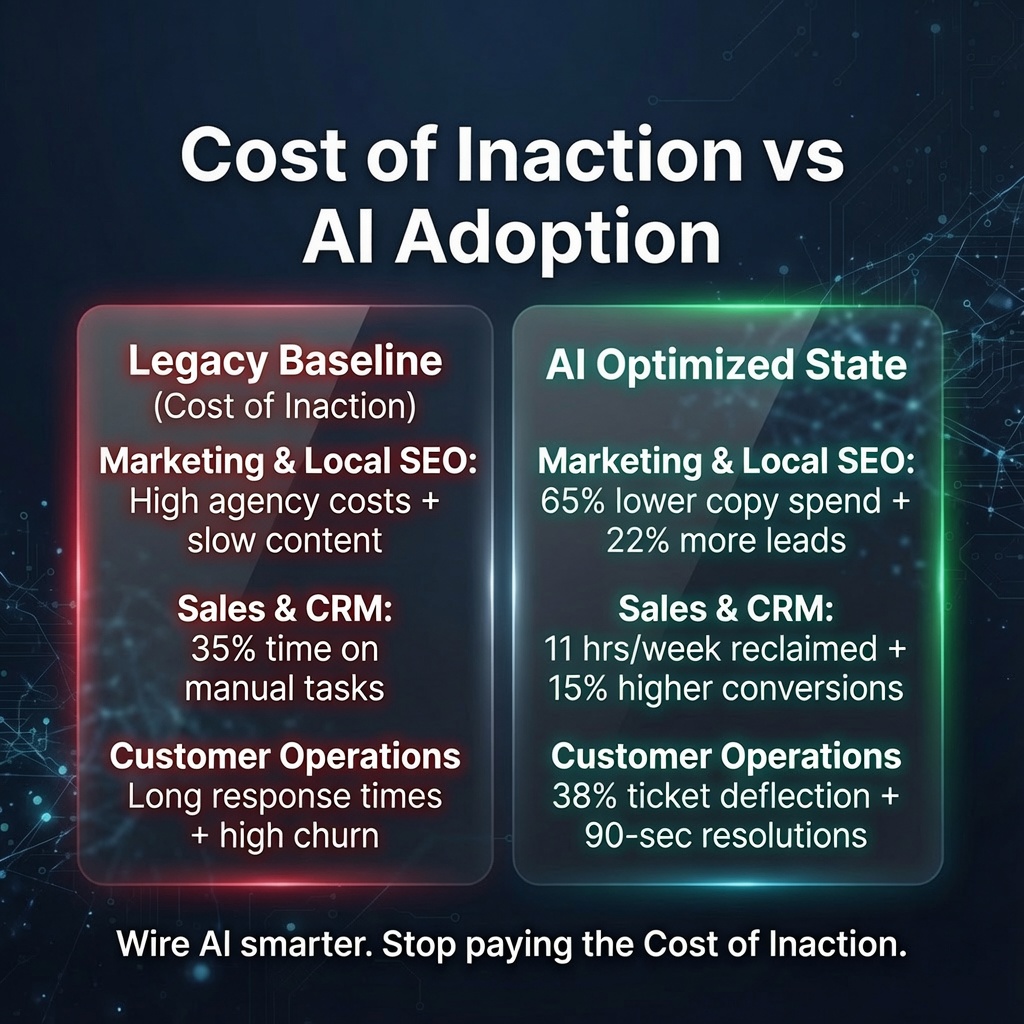
The Cost of Inaction (COI) vs. The Cost of AI Adoption
Failing to evolve incurs a structural tax. Below is a detailed matrix contrasting the operational realities of an SMB remaining tethered to legacy processes versus one executing a targeted, high-ROI AI strategy across three core business units.
Department: Marketing & Local SEO
Legacy Baseline (COI): High reliance on agencies for regional copy creation. Slow content output limits search visibility. Minimal personalization based on local search trends.
Optimized State (AI Adoption): In-house generation of localized content variants via fine-tuned LLMs. Automated structured data markup deployment. 4x increase in content production velocity.
Quantifiable Financial Lever: 65% reduction in external copywriting spend. 22% increase in organic local inbound leads within 6 months.
Department: Sales & CRM Management
Legacy Baseline (COI): Reps spend 35% of their day manually logging notes, updating pipelines, and emailing unqualified prospects. Human error leads to missed follow-ups.
Optimized State (AI Adoption): Automated email synthesis, smart CRM enrichment, and predictive lead prioritization algorithms. High-intent prospects surface automatically.
Quantifiable Financial Lever: Reclamation of 11 hours/week per sales representative. Directly translates to 15% higher pipeline velocity and conversion rates.
Department: Customer Operations
Legacy Baseline (COI): Tier-1 support queues clog internal staffing capacity. Long weekend response delays drive customer churn. Staff burnout from answering repetitive FAQs.
Quantifiable Financial Lever: 38% deflection rate of inbound support tickets. Average resolution time drops from 14 hours to 90 seconds for standard inquiries.
4. Five Practical, High-ROI AI Use Cases for SMBs
To maximize performance, an SMB should avoid broad, generalized AI toolsets and instead focus on deploying targeted capabilities aligned with specific workflow friction points. Below are five foundational frameworks designed to optimize how to implement AI in small business environments.
Use Case 1: Automated Customer Support & Triage via Retrieval-Augmented Generation (RAG)
The Operational Pain Point: An SMB e-commerce brand or regional service provider experiences a high volume of inbound tier-1 support requests (e.g., tracking numbers, return policies, warranty confirmations). Human agents spend over 40% of their day pasting templated responses. This creates response backlogs during peak hours and weekends, driving up customer churn and increasing staffing costs.
The AI Tactical Solution: Deploy a context-aware RAG chatbot natively integrated into the existing support ticketing platform (such as Zendesk, Freshdesk, or Intercom). Unlike standard, rigid decision-tree bots, a RAG system reads the company’s internal knowledge base, historical resolved tickets, and real-time shipping databases to generate highly accurate, conversational, and natural language responses. It can answer specific questions—such as, "Where is my order #1094 and can I change the shipping address?"—by executing secure database lookups. If the confidence score drops below 85% or the sentiment analysis detects intense customer frustration, the system seamlessly escalates the ticket to a live human agent with a concise summary of the interaction pre-populated.
The Required Tooling Class: Custom interface layers built via low-code platforms (e.g., Voiceflow, Botpress) utilizing APIs from foundational model providers (e.g., OpenAI, Anthropic), or native AI add-ons within existing enterprise support platforms.
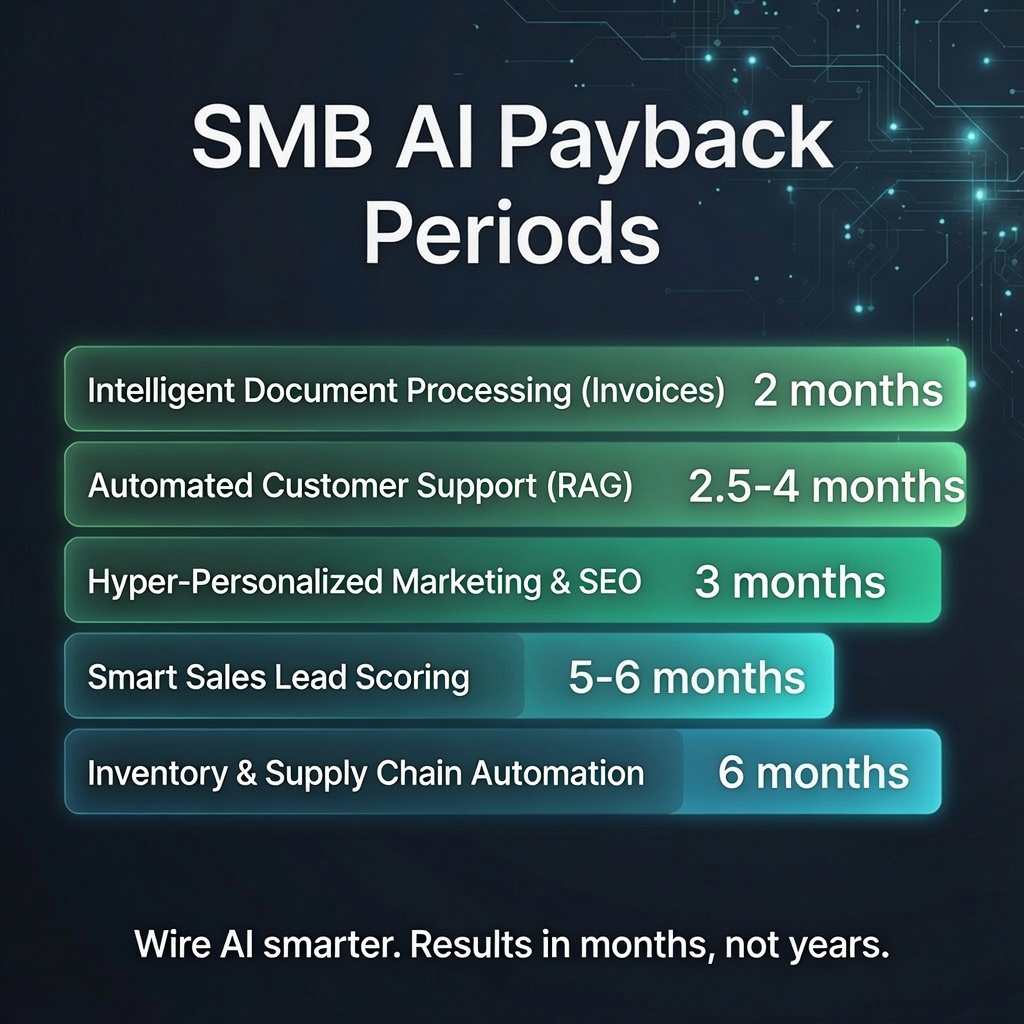
The Expected Payback Period: 2.5 to 4 Months.
Use Case 2: Hyper-Personalized Marketing Assets & Local SEO Localization
The Operational Pain Point: A multi-location franchise or regional B2B service firm struggles to maintain a consistent search presence across dozens of unique zip codes. Custom-writing hundreds of hyper-local landing pages, Google Business Profile updates, and ad creative variations is cost-prohibitive, forcing reliance on expensive, slow agency retainers.
The AI Tactical Solution: Implement an automated editorial workflow engine utilizing specialized LLM agents. The system ingestion layer takes core brand guidelines, product specifications, and target demographic data, and maps them against real-time local search trends and localized geographic data. The system automatically outputs unique, contextually relevant, SEO-optimized landing page copy, geo-targeted blog content, and structural schema markups tailored to each specific municipality. This ensures content variations remain unique and clear of search engine duplication penalties, while matching local search intent.
The Required Tooling Class: Specialized content orchestration tools (e.g., Jasper Business, Writer, Copy.ai) or custom python scripts leveraging LangChain and open-source models hosted via lightweight cloud services.
The Expected Payback Period: 3 Months.
Use Case 3: Smart Sales Lead Scoring & Predictive CRM Forecasting
The Operational Pain Point: B2B SaaS and service-based SMBs often generate a high volume of raw marketing leads through downloads and webinars, but sales reps waste critical time calling unqualified or low-intent prospects. Conversely, high-value opportunities stall in the pipeline due to a lack of visibility into when a prospect is actually ready to buy.
The AI Tactical Solution: Embed predictive lead scoring models directly into the corporate CRM database. The AI constantly monitors historical conversion patterns, assessing variables such as job titles, company firmographics, website interaction frequency, email open rates, and intent signals from third-party data networks. The algorithm automatically ranks leads on a dynamic 1-100 scale. High-scoring leads automatically trigger real-time alerts to account executives alongside an AI-synthesized brief detailing the prospect's likely pain points and recommended value propositions.
The Required Tooling Class: Native predictive intelligence modules built into premium tiers of standard CRM platforms (e.g., Salesforce Einstein, HubSpot AI) or standalone middleware integrations (e.g., MadKudu).
The Expected Payback Period: 5 to 6 Months.
Use Case 4: Unstructured Data Extraction for Invoices, RFPs, and Legal Contracts
The Operational Pain Point: Accounts payable, logistics, and professional service firms handle hundreds of unstructured documents monthly—including multi-page PDF invoices, complex government RFPs, and vendor contracts. Manual data entry into accounting software or procurement sheets is slow, prone to keystroke errors, and introduces severe delays into cash flow cycles.
The AI Tactical Solution: Deploy an Intelligent Document Processing (IDP) workflow utilizing Optical Character Recognition (OCR) coupled with fine-tuned LLM vision and extraction capabilities. When a document is received via email or upload, the system automatically parses the unstructured text, identifies key-value pairs (such as line-item descriptions, tax IDs, net terms, and total amounts due), cross-references the data against corresponding purchase orders, and stages the clean data for approval within the company's accounting software or ERP system. Any discrepancy immediately flags the document for manual review by a financial coordinator.
The Required Tooling Class: Modern IDP platforms (e.g., Rossum.ai, Docparser, or AWS Textract integrated via low-code automation tools like Make or Zapier).
The Expected Payback Period: 2 Months.
Use Case 5: Operations & Inventory Supply Chain Automation
The Operational Pain Point: SMB distributors, wholesalers, and light manufacturing firms often manage inventory using static spreadsheets or basic reorder points. This approach regularly triggers costly stockouts of critical items, or conversely, ties up valuable working capital in excess inventory due to unpredictable demand shifts.
The AI Tactical Solution: Apply time-series forecasting algorithms and machine learning models to historical sales data, seasonal variations, regional weather shifts, and macroeconomic indicators. The predictive inventory engine constantly calculates future product demand down to the individual SKU level. The software automatically generates optimized procurement recommendations, adjustments to safety stock thresholds, and can even auto-draft purchase orders for supplier approval when stock levels cross dynamically calculated risk thresholds.
The Required Tooling Class: AI-driven inventory management add-ons or predictive analytics layers (e.g., Inventory Planner, StockTrim) running natively on top of standard SMB inventory systems.
The Expected Payback Period: 6 Months
5. Step-by-Step Blueprint: Building the Business Case Presentation
To successfully secure approval for an AI strategy from ownership, partners, or financial stakeholders, an internal champion must convert tactical concepts into a structured, formal business proposal. This five-step methodology serves as your operational blueprint.
Step 1: Executive Summary & Strategic Alignment
Step 2: Baseline Assessment & Diagnostic Sprint
Step 3: Rigorous Vendor & Tech Stack Evaluation
Step 4: Phased Agile Rollout Blueprint
Step 5: Governance, Security, and Compliance Summary
Step 1: Executive Summary and Strategic Alignment
Open the proposal by defining the concrete strategic goal. Do not speak about technology; speak about business objectives. Define how the initiative aligns with the company’s immediate quarterly or annual goals—whether that is expanding net margins by 4%, scaling customer output without increasing administrative headcount, or modernizing client response times to win market share from local competitors. Frame AI strictly as an operational lever to solve a high-priority business challenge.
Step 2: Baseline Assessment and Diagnostic Sprint
Document the current state of operations. Present clear, unvarnished data collected during a brief internal diagnostic sprint. For example:
"Our customer support team currently spends an average of 142 hours per month responding to identical shipping status inquiries. At our burdened labor rate, this costs the company approximately $4,970 every month, while keeping our average response time at a slow 8.2 hours."
Establishing this firm, auditable baseline gives you a clear point of comparison to accurately measure future success.
Step 3: Vendor Evaluation and Tech Stack Validation
Present a transparent breakdown of the recommended vendor solution, contrasting it against at least two alternatives (including the status quo). Clearly outline the cost parameters associated with the selection:
Fixed Upfront Costs: Setup fees, software customization, API configuration, and employee training.
Variable/Recurring Costs: Monthly platform licensing fees, user seat costs, and anticipated API token usage fees.
Integration Audit: Document exactly how the chosen software interacts with your current software suite, ensuring that the IT infrastructure can support the tool out-of-the-box without requiring custom developer overhead.
Step 4: The Phased Agile Rollout Blueprint
Mitigate stakeholder fear of operational disruption by proposing a tightly controlled, iterative implementation schedule. Avoid massive, company-wide launches. Instead, structure a phased approach:
Days 1–30 (The Isolated Pilot): Deploy the AI tool within a single, highly controlled department or workflow (e.g., a pilot with one customer support agent or automating a single type of invoice). Measure performance closely against your baseline.
Days 31–60 (Optimization & Review): Review performance data, fix software bugs, fine-tune model prompts, and update internal training documentation based on user feedback.
Days 61–90 (Full Production Scaling): Expand the system across the broader business unit and initiate formal training protocols for all relevant team members.
Step 5: Governance, Security, and Compliance Summary
Conclude the presentation by proactively addressing risk management. Detail the exact data security measures that will be deployed to safeguard company assets, protect intellectual property, and ensure complete compliance with local privacy frameworks. This reassures stakeholders that innovation will not come at the cost of operational security.
6. Mitigating the Risks: Security, Ethics, and Governance for SMBs
While the competitive advantages of AI are substantial, improper implementation can expose an SMB to severe operational, financial, and legal liabilities. Managing these vulnerabilities does not require a large corporate compliance legal team; it requires adhering to a strict, foundational risk management framework.
Protecting Data Privacy and Intellectual Property
The most common mistake made by SMB employees is pasting sensitive corporate assets—such as proprietary financial records, client lists, or sensitive legal contracts—into public consumer AI interfaces. When using standard, free tiers of consumer tools, the provider often retains the input data to further train future iterations of their public models. This can lead to inadvertent data leaks to competitors.
The Remedy: Every SMB must establish formal enterprise contracts with vendor platforms or use developer API endpoints. Enterprise agreements explicitly state that input data remains the sole property of the user organization and is legally restricted from being used for public model training.
Eradicating Hallucinations and Managing Accuracy
Generative AI models are predictive text engines; they are built to optimize for plausibility rather than absolute truth. Consequently, they can "hallucinate"—generating incorrect facts, fabricated statistics, or flawed legal citations with absolute confidence.
The Remedy: For any customer-facing or financially sensitive output, implement a strict "Human-in-the-Loop" (HITL) workflow. AI should be positioned as an efficiency assistant that drafts content or synthesizes information, but a qualified human professional must review, verify, and approve the output before it is finalized or sent to a client.
Avoiding Vendor Lock-In
The current AI software ecosystem is highly volatile, with model capabilities expanding rapidly and pricing structures shifting frequently. Tying an SMB's long-term operational workflows to a single, proprietary niche vendor creates structural vulnerability. If that vendor increases prices, suffers prolonged downtime, or falls behind technologically, your business suffers.
The Remedy: Design your AI architecture to be modular and platform-agnostic. Use middleware solutions, open-source integration frameworks, or well-documented APIs that allow you to easily swap out the underlying AI engine (e.g., transitioning from one LLM provider to another) without needing to rebuild your entire frontend user workflow or internal databases.
The SMB AI Governance Checklist
To guarantee compliant and safe execution, ensure your leadership team checks off every item on this operational protocol before moving past the pilot phase:
[ ] Enforce Zero Data-Training Tiers: Verify that all corporate accounts use enterprise data privacy terms or API access models to prevent company inputs from being used for public model training.
[ ] Implement Multi-Factor Authentication (MFA) & Role-Based Access Control (RBAC): Restrict AI admin settings, database integration keys, and API credentials to authorized personnel only.
[ ] Establish an Explicit Employee Usage Policy: Draft, distribute, and enforce a clear internal policy detailing approved and prohibited AI use cases across the business.
[ ] Enforce Human-in-the-Loop (HITL) Mandates: Require human verification for all customer-facing communications, financial calculations, and binding legal text generated by AI.
[ ] Set Up a Continuous Error and Hallucination Log: Monitor system performance weekly to track accuracy, identify edge cases, and fine-tune system prompts or knowledge bases accordingly.
7. Conclusion & Actionable Next Steps
The integration of artificial intelligence within Small and Medium Businesses is not a futuristic concept; it is a current operational reality. The core differentiator between firms that generate real value and those that waste capital is a structured, mathematically sound business case. By shifting focus away from general industry hype and toward specific, high-frequency process bottlenecks, SMB leaders can deploy highly targeted solutions that drive measurable bottom-line growth.
The strategic advantage belongs to those who act early but execute with disciplined precision. Do not wait for a perfect, company-wide strategy. Select a single, high-friction workflow within your organization today, calculate its baseline cost structure using the formula provided, and launch a controlled, 30-day isolated pilot.
Optimize current efficiency calculations: Calculate operational baseline metrics
Draft your internal proposal: Generate an executive pitch deck template
Build an internal framework: Create a customized corporate AI usage policy
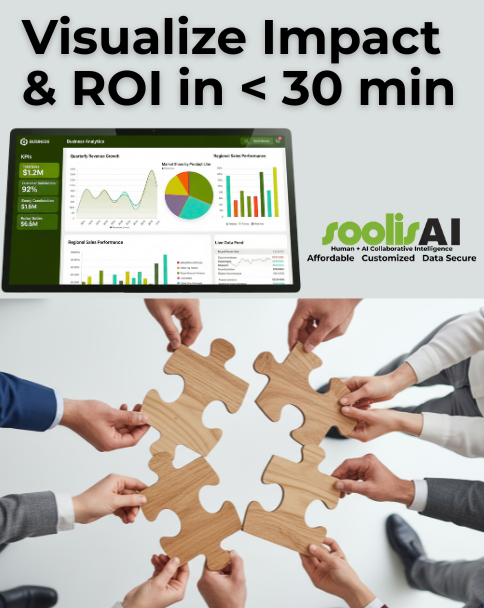
FREE LIVE DEMO: See your ROI in seconds
We value your time. Visualize the possibilities < 30 min!
Thank you! Your submission has been received!
Oops! Something went wrong while submitting the form.