The modern enterprise is facing a foundational architectural crossroads that will dictate its operational efficiency, data sovereignty, and balance sheet health for the next decade. The choice between closed-source, proprietary artificial intelligence and open-weights, community-driven models is no longer just a technical debate for software engineers. It is a high-stakes strategic decision requiring rigorous evaluation by chief technology officers, financial officers, and information security leaders.
Understanding the structural, economic, and philosophical chasms between these two paradigms is essential for navigating the rapidly evolving generative AI landscape. This guide provides a deep-dive, data-driven analysis of closed versus open AI models, establishing a clear framework for enterprise deployment and long-term technological agility.
A closed AI model is a proprietary artificial intelligence system where the underlying source code, neural network architecture, training methodologies, and model weights remain completely hidden from the public and the end-user. Access to these systems is strictly regulated and provisioned exclusively through managed application programming interfaces (APIs) or secure cloud platforms controlled by the vendor. The provider assumes full responsibility for hosting the infrastructure, managing model updates, maintaining uptime, and enforcing behavioral guardrails, while treating the model itself as a protected intellectual property asset.
An open AI model is an artificial intelligence system that grants developers and enterprises public access to its core architectural components, most notably its trained parameters or "model weights." Depending on the specific licensing agreement, an open model allows organizations to download, inspect, modify, and host the system on their own infrastructure without relying on a third-party API. While the term can encompass fully open-source projects that disclose training data sets and source code, in the enterprise landscape, it primarily refers to open-weight models that empower organizations to execute local fine-tuning and exercise absolute operational control.
Closed models consistently represent the absolute bleeding edge of artificial intelligence capabilities at any given moment. The massive capital expenditure required to train trillion-parameter frontier systems means proprietary vendors are typically the first to break through reasoning, multimodal, and agentic benchmarks. Enterprises with highly complex, non-linear workflows select closed models because they require the absolute maximum cognitive baseline available on the market to execute sophisticated tasks without system failure.
Choosing a closed model allows an enterprise to completely offload the operational burdens of infrastructure management, hardware provisioning, and system scaling. Organizations do not need to secure scarce AI hardware pipelines or maintain complex Kubernetes clusters to manage inference workloads. This zero-infrastructure reality allows enterprise development teams to move from proof-of-concept to production in a fraction of the time, bypassing the specialized hiring pipeline required for deep infrastructure engineering.
Proprietary AI vendors provide robust, enterprise-grade legal frameworks that shield corporate clients from copyright infringement liabilities and data non-compliance penalties. Closed model providers typically offer explicit contractual guarantees that customer data will not be used to train future public iterations of the model. Furthermore, these platforms come equipped with pre-integrated content moderation, prompt-injection shielding, and threat management layers that satisfy corporate legal and compliance departments right out of the box.
The closed-model architecture is fundamentally a "black box" system where the enterprise has zero visibility into the inner workings of the model.
Open models reverse this dynamic by handing the keys of the actual model artifact directly to the enterprise engineering team.
Deploying open models at scale demands a rigorous understanding of the underlying hardware requirements, which contrasts sharply with the outsourced nature of closed models.
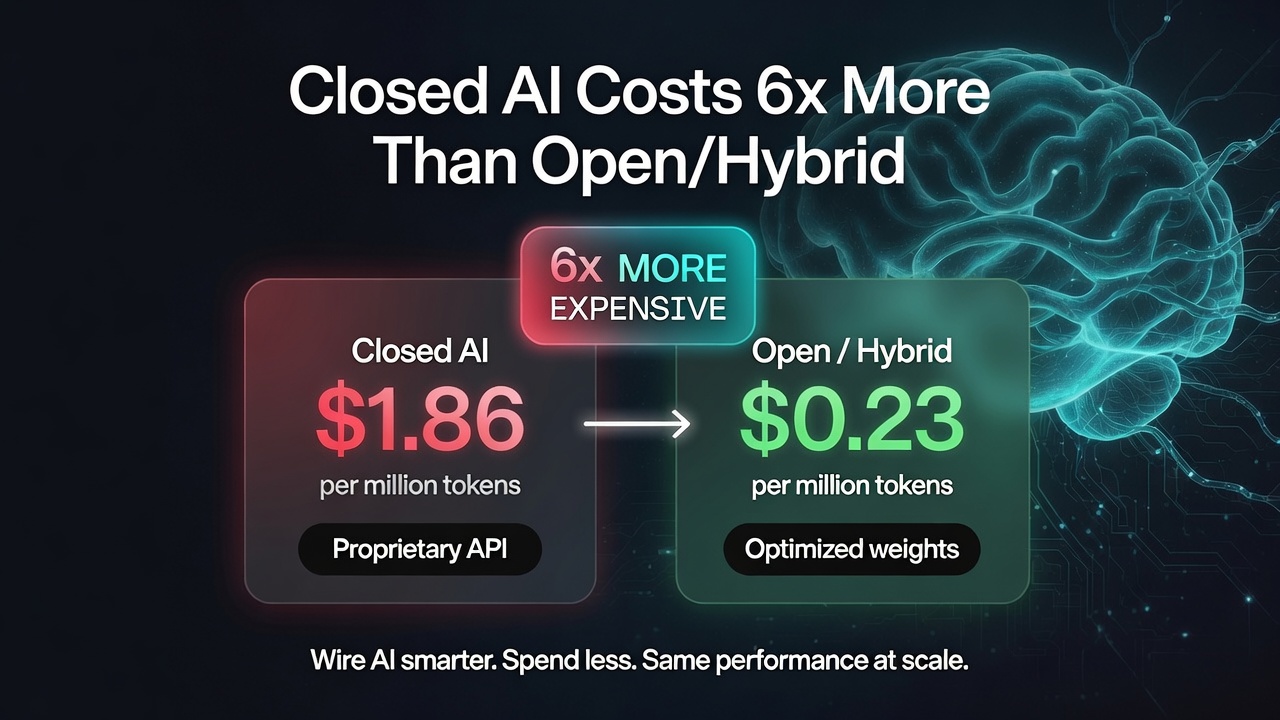
The economic landscape of generative AI is characterized by a stark contrast between usage volume, revenue generation, and raw unit economics.
While closed models hold the initial revenue edge, the speed at which the open-source community erodes that technical advantage is unprecedented.
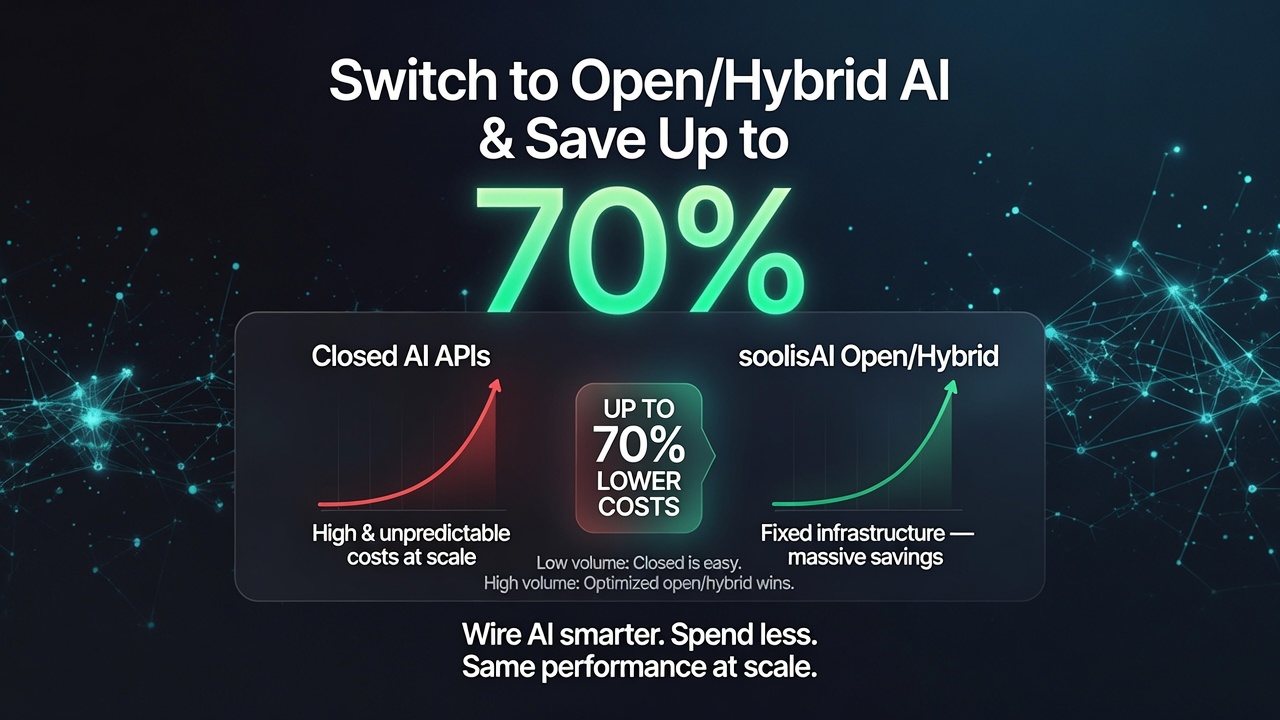
When calculating Total Cost of Ownership (TCO) for applications processing millions of transactions daily, the financial calculus shifts dramatically toward open ecosystems.
For organizations operating within highly regulated frameworks—such as global banking, clinical healthcare, and national defense—the transmission of data across external boundaries is a critical vulnerability.
Conversely, for enterprises outside of hyper-regulated environments, closed model providers have developed sophisticated, ironclad security infrastructures that mitigate the majority of traditional cloud risks.
The internal architectural alignment of closed models is entirely controlled by the corporations that build them, creating operational friction for certain enterprise use cases.
When an enterprise requires a model to master a highly specialized language, unique codebase, or proprietary internal nomenclature, standard prompting often falls short.
An undeniable structural shift is occurring across the enterprise software landscape, mirroring the open-source operating system revolutions of the late 1990s and early 2000s. Organizations are increasingly looking to move away from complete vendor lock-in toward a hybrid, open-core model architecture.
This trend has accelerated the emergence of specialized enterprise AI platforms acting as the "Red Hat of AI." These enterprise partners wrap raw, open-weight models in commercial-grade management layers, providing the necessary security patching, deployment optimization, and technical support that large corporations require.
By embracing this open-core architectural shift, enterprise organizations are successfully executing migrations that yield up to 70% savings in ongoing compute and token costs. At the same time, they completely eliminate the long-term risk of data privacy breaches and strategic reliance on a single proprietary AI vendor. This hybrid strategy allows companies to use closed models for rapid, exploratory prototyping while systematically transitioning mature, scaled workflows onto highly optimized, owned open infrastructure.
The primary difference lies in the accessibility of the model's core internal parameters, known as weights, and the method of deployment. Closed AI models are proprietary systems hosted entirely by the vendor, accessible only through a controlled cloud API that hides the internal neural network architecture. Open AI models grant public access to their trained weights, allowing organizations to download, modify, fine-tune, and host the system locally on their own private infrastructure with absolute operational control.
Yes, open-source AI models are highly secure and safe for enterprise use, provided the organization establishes proper deployment and governance protocols. Because open models can be hosted entirely within a company’s secure private cloud or on-premise data center, they eliminate the risk of sensitive data leaking to external third-party vendors. However, unlike closed models that come with built-in content filtering, open models require enterprise engineering teams to manually implement their own security guardrails, vulnerability scanning, and compliance layers.
Enterprises transitioning high-volume applications from closed APIs to optimized open models regularly realize compute and token infrastructure savings of up to 70%. While closed models cost an average of $1.86 per million tokens due to vendor premiums, open-source alternatives average just $0.23 per million tokens for equivalent raw throughput. These savings are achieved at scale by breaking the linear pricing models of proprietary APIs and leveraging quantization techniques to pack models onto highly efficient internal hardware configurations.
Open models are structurally superior for proprietary data fine-tuning because they grant absolute access to the model’s internal weights, layers, and embeddings. This architectural transparency allows enterprise developers to utilize advanced, localized fine-tuning techniques like Low-Rank Adaptation (LoRA) to embed niche corporate knowledge directly into the system. While closed models do offer fine-tuning via proprietary APIs, they introduce substantial vendor lock-in, carry higher synthetic data fees, and prevent you from exporting your newly customized intellectual property to alternative infrastructure.
We value your time. Visualize the possibilities < 30 min!