McKinsey’s August 2026 study on embedding AI into product-development workflows is an account of what happens when generic tools are applied to work that has never been specified end to end.
The finding that should matter to mid-market leaders is that organizations that redesigned processes before incorporating the technology were more than twice as likely to report productivity gains of more than 20 percent.
McKinsey measured that result in product-development teams. The universal concept is the workflow itself: map the path, then apply the model. Every company moves work from trigger to outcome. The recommended method is to start simply: identify the defects in that path, test a defined point of impact, and only then apply a small-scope model.
McKinsey asked senior leaders whether AI was actually making their teams more productive, and the compiled replies tell a disturbing story.
The separator was not access to models.
Those statistics describe an AI onboarding problem. Companies purchase copilots, public models, and other off-the-shelf tools before they have identified the core workflow defects affecting time, margin, and return. Because the departments that complete the same workflow still work from disconnected records, the technology cannot be applied as one results-driven process.
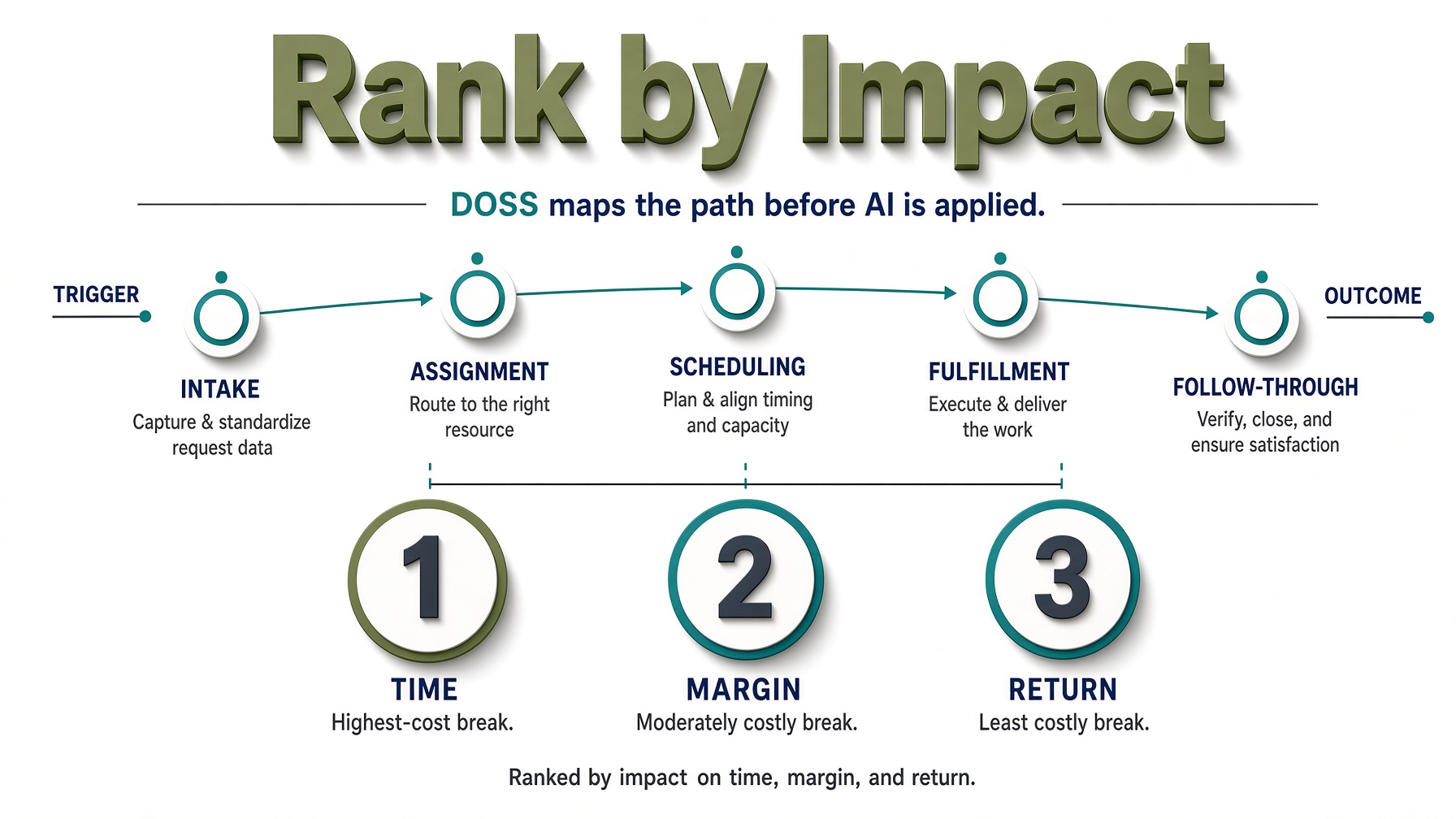
McKinsey recommends starting with the highest-value workflows and mapping them from trigger to outcome. An AI application added to day-to-day operations will not produce a measurable result if the underlying process is still disconnected and unproductive.
That mapping is the function of DOSS, an operations foundation used to see how daily work actually moves: intake, assignment, scheduling, fulfillment, documentation, and follow-through. It traces the ordinary path of an inquiry, an order, an appointment, a ticket, a referral, a reservation, or a shipment as that work crosses departments.
The analysis is used to identify and rank those concerns. Not every disconnected record carries the same economic weight. Some defects add labor hours. Some destroy utilization. Some delay cash conversion. Some raise cost-to-serve every week. Starting simply means isolating those defects and ordering them from greatest to least impact before a model is trained.
The ranking also determines whether time saved in the workflow turns into a result leadership can measure. McKinsey respondents reported average time savings of 11.8 percent against rework reduction of only 6.2 percent. Labor moved faster, but the work did not get clean enough to protect utilization, margin, or return. That leftover rework is why an application attached to an unmapped path produces activity without a durable ROI. It is what remains when a model is applied before the defects have been identified and ordered.
A mapped workflow still fails if the AI model applied is an off-the-shelf public system trained on undifferentiated data.
Public models are not trained on a company’s proprietary operating data. They cannot see this organization’s appointment utilization, inventory movement, referral queue, exception log, or location-level fulfillment. The competitive consequence is a flattened capability set: the same answers available to every rival using the same public platform.
soolisAI’s published operating results show that privately trained models built on first-party data typically produce 20 to 40 percent stronger performance than undifferentiated models. The advantage is a tailored fit. Those AI solutions work off the same proprietary operating data the team already uses to run the workflow.
Trust and control are both essential parts of a DOSS-based operational restructuring. People use what they trust. McKinsey reported that only 3.1 percent of respondents had high trust in AI outputs, and that 45 percent of tested AI-generated code samples failed security checks. The design requirement is therefore specific: keep the company’s private proprietary data inside the application, subject outputs to expert review, and leave direction, trade-offs, and validation with the people accountable for the result.
Expert-led human–AI collaboration embeds specialists in the existing teams responsible for those workflow outcomes. The privately trained model supports the mapped process from intake through follow-through, rather than operating as a detached public tool. The practical effect is that a mid-market company can put a verified application to work without first standing up, staffing, and funding a large internal AI team.
Once the workflow has been mapped, the defects have been ranked, and a defined point of impact has been tested, leadership should require movement in labor hours, utilization, completion, margin, and return.
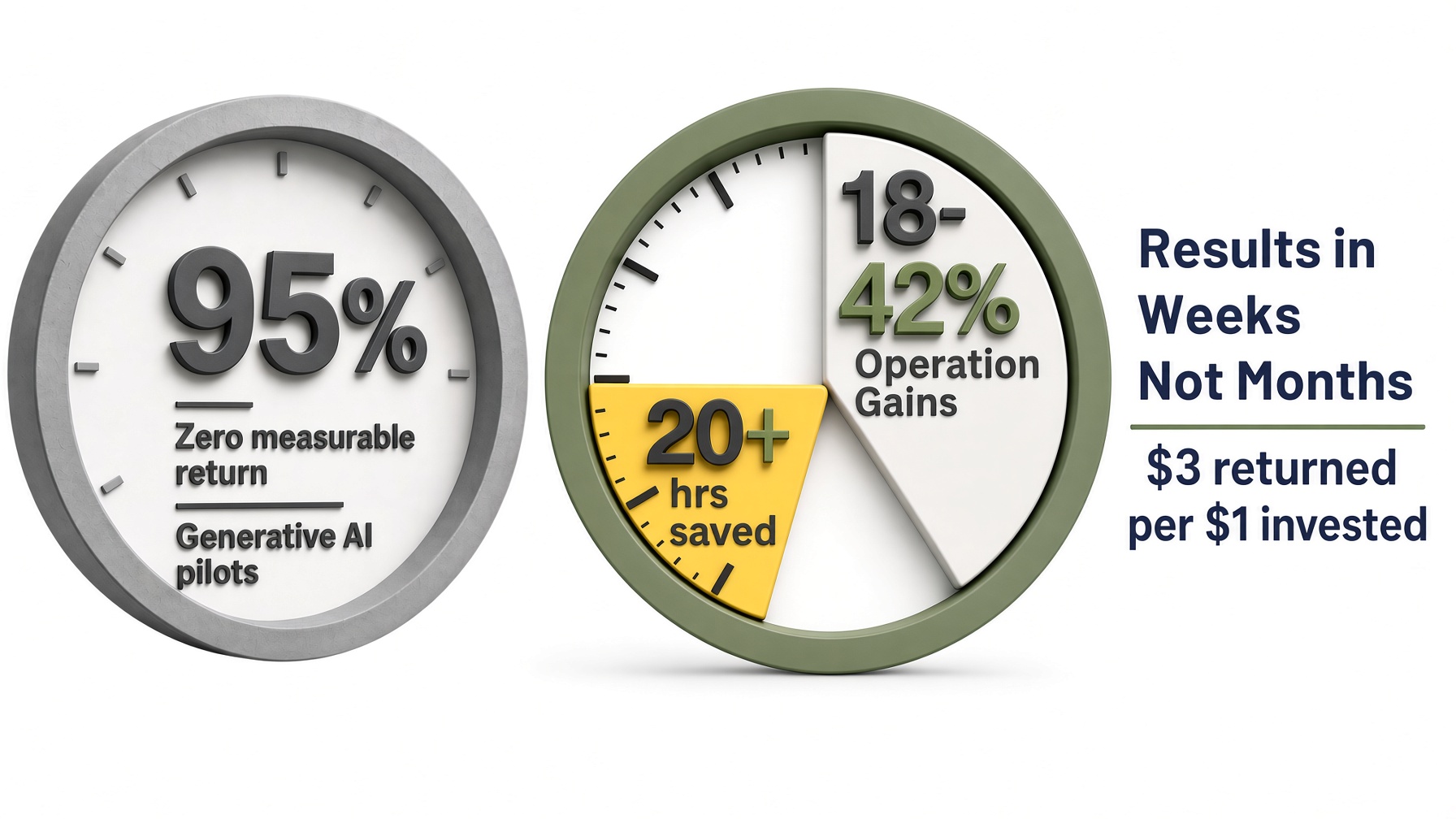
Focused applications on revised workflows produce improvement in the 18 to 42 percent range. Teams often recover 20 or more hours a month in the affected process because labor is no longer absorbed by rework, dual entry, status-chasing, and manual follow-through. A working application can be in production in weeks rather than months when scope is held to a named workflow, a named data source, and a named metric.
Companies that begin with a defined operations foundation and then apply models tailored and trained on private native data only at the highest-impact points also show stronger economics on work already in motion — often about 20 percent more profit from day-to-day activity, and roughly $3 returned for every $1 spent. That is the measurable return on a single ranked workflow, not the promised yield of a company-wide transformation.
McKinsey found that spend on tokens, compute, infrastructure, and related AI operations can rise to as much as 20 percent of existing labor costs. A generic, one-size-fits-all model is therefore expensive in operating budget and in the man-hours required to keep an undefined process moving. That is not the better choice. The better choice is to begin with a DOSS analysis, integrate the mapped workflow, and apply a bounded private model only where the metric can move.
The performance gap is already visibleMcKinsey asked senior leaders whether AI was actually making their teams more productive, and the compiled replies tell a disturbing story.
The separator was not access to models.
Recent research has also found a similar pattern beyond software teams.
Those statistics describe an AI onboarding problem. Companies purchase copilots, public models, and other off-the-shelf tools before they have identified the core workflow defects affecting time, margin, and return. Because the departments that complete the same workflow still work from disconnected records, the technology cannot be applied as one results-driven process.
McKinsey reports that the top-performing organizations did not add tools to unchanged routines. They embedded AI in the workflow, adjusted ways of working, and kept verification in the path. Product managers in those organizations reported a 24 percent reduction in time spent on execution; developers reported 19 percent. The capacity came from higher-yield work, not from a broader set of applications.
After the first small-scope application is verified, expansion should follow the same rule inside the company. If inbound inquiries improved and scheduling utilization did not, capital stays with the workflow that moved. The next application is chosen the same way: by economic impact. It may sit in a different department and address inventory availability, appointment follow-through, exception handling, or cross-team coordination.
The method is built to travel. Workflows differ by department and by sector. The sequence stays the same: map the path, identify the defect, test a defined point of impact, apply a small-scope model, then reuse that method across departments after the metric has moved. This DOSS-based process is designed for that reuse. It can be applied across sectors, industries, and organizations of different sizes and operating structures.
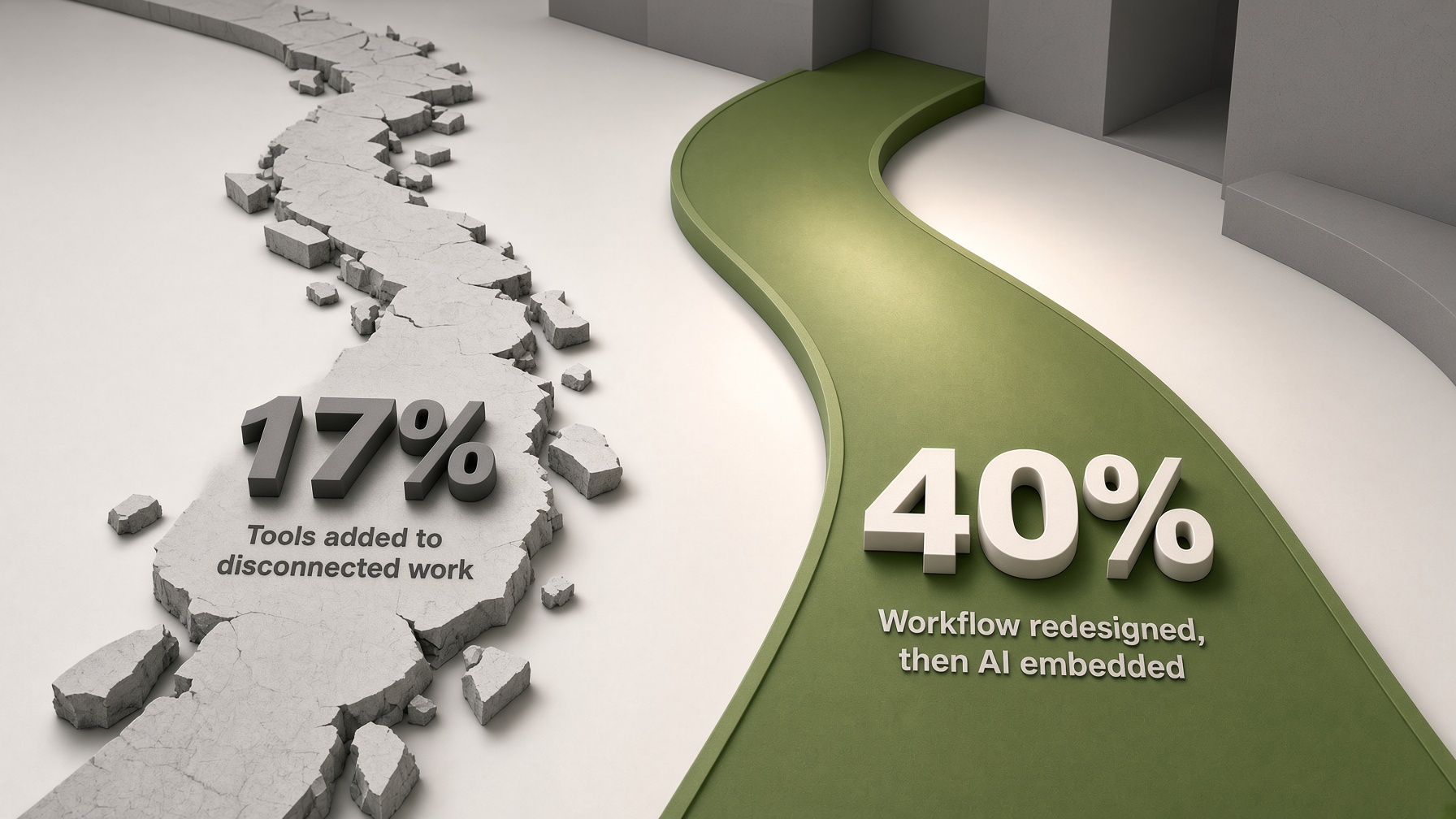
McKinsey’s warning is direct: the payoff stays limited when copilots, public models, and other off-the-shelf applications are dropped onto disconnected day-to-day work. Only 25 percent of senior leaders in that study reported meaningful productivity gains. Thirty percent said productivity fell. Organizations that redesigned the workflow before incorporating AI were more than twice as likely to see gains above 20 percent. Those that bought tools without embedding them in the work reached top-tier results only 17 percent of the time.
The case for a DOSS-based analysis path is clear.
Do not invest valuable operating budget, leadership time, and staff hours in a one-size-fits-all application and then search for a use case that can justify the spend. Unscoped AI can itself consume as much as 20 percent of existing labor cost.
That sequence is already structured as Start Simple. Scale Where It Counts. DOSS is the mapping foundation. Both are in place at soolisAI for SMB and mid-market teams that need this executed against live workflows, not against a platform shortlist.
Sources
McKinsey & Company, “Beyond the copilot: Scaling the agentic product development life cycle,” August 2026. soolisAI published operating results: 18–42% improvement, 20–40% first-party performance lift, 20+ hours a month, weeks not months, and approximately $3 returned per $1 spent. Additional industry findings cited: roughly two-thirds of organizations have not begun scaling AI; 95% of generative AI pilots show no measurable return; more than 80% of traditional ERP and core-system projects miss budget, timeline, or value goals.
We value your time. Visualize the possibilities < 30 min!