Author: Timothy Sebold, CEO, soolisAI
For thirty years, I’ve watched industries—from fitness to marketing—struggle with the same problem: Data rich, insight poor.
We used to rely on spreadsheets. Then came static dashboards—pretty charts that told us what happened last month. Today, that isn't enough. In an era where customer sentiment shifts in seconds and supply chains break down in minutes, real-time data visualization is the baseline for survival.
But here is the hard truth that most "Top 10" lists won't tell you: Not all AI dashboards are created equal.
Most platforms on the market today offer "Generic AI"—off-the-shelf models that apply the same logic to your business as they do to your competitors. While tools like Salesforce, Looker, and Domo have defined the last decade of Business Intelligence (BI), the next decade belongs to Private, Closed-Model AI—systems trained exclusively on your first-party data to deliver insights that are actually competitive, not just comparative.
In this guide, I will analyze the top performers in the market—Salesforce, Google Looker, and Domo—and explain why a shift toward custom, secure AI solutions (like what we build at soolisAI) is the necessary evolution for serious enterprise growth.
Before we critique the platforms, we must define the standard. A true AI dashboard does not just display data; it interrogates it.
To rank as a "Top Platform" in 2026, a tool must meet these E-E-A-T (Experience, Expertise, Authoritativeness, Trust) criteria:
I have analyzed the current top-ranking solutions—Salesforce Tableau, Google Looker Studio, and Domo. Here is an honest executive breakdown of where they excel and where they leave modern businesses exposed.
The Heavyweight Champion of Complexity
Salesforce is the behemoth. With their integration of Tableau and the new Agentforce, they offer one of the most robust visualization ecosystems on the planet.
The Accessible Utility
Google’s rebrand of Data Studio to Looker Studio cemented its place as the "go-to" for marketers.
The Agile Challenger
Domo has aggressively pivoted to AI with their "AI Chat" and "Domo.AI" features.
The three platforms above share a common flaw: They are "Open/Generic" Model architectures.
They apply the same algorithms to a hospital system as they do to a retail chain. They are broad, not deep.
At soolisAI, we have taken a radically different approach. We believe that your data is your most valuable asset, and it shouldn't just be visualized; it should be used to train a Private AI that belongs to you.
We don't just sell you a subscription to a dashboard; we build Custom Data Engines. By leveraging technologies like Amazon Q and QuickSight with SPICE (Super-fast, Parallel, In-memory Calculation Engine), we deliver dashboards that are fundamentally different from the SaaS giants.
1. 1st-Party Data Security (The "Closed" Model)
Unlike generic tools that might use your data to improve their public models, soolisAI builds isolated, private environments. Your data trains your AI agent. This means your dashboard learns your specific acronyms, your specific seasonal trends, and your specific customer behaviors.
2. Real-Time Action, Not Just Visualization
Most dashboards have a "latency lag"—data is refreshed every hour or day. soolisAI dashboards operate on streaming data.
3. Answer Engine Optimization (AEO) for Your Business
We build dashboards you can talk to. But unlike the basic "Chat with Data" features of others, our Omnichannel Route Filters understand intent.
If you are evaluating vendors, use this checklist to ensure you are buying a future-proof solution.
Your dashboard must consume unstructured data (emails, chat logs, voice calls) and structure it visually.
Stop looking in the rearview mirror.
The dashboard should not be a silo. It should trigger actions.
I often reference my background in fitness because it is a high-volume, low-margin game where data efficiency is king.
We worked with a large fitness franchise struggling with "Churn Blindness." They had Tableau, but they couldn't see the correlation between front-desk check-in delays and cancellation rates until months later.
By implementing a soolisAI Custom Dashboard:
Generic tools visualize the problem. Custom AI solves it.
The era of renting "one-size-fits-all" intelligence is ending. If you want to rank #1 in your industry, you cannot use the exact same tools and strategies as the company ranked #2.
You need a Partner, not just a Platform.
At soolisAI, we don't just hand you a login and wish you luck. We act as your AI Architects. We clean your data, secure your private model, and build the custom visualization layer that aligns perfectly with your specific KPIs—whether you are in healthcare, hospitality, or retail.
Don't settle for a dashboard. Build a Competitive Advantage.
Let’s have a real conversation about your data infrastructure. No sales scripts, just strategy.
Schedule a Direct Meeting with Tim Sebold
Q: What is the difference between AI dashboards and traditional BI dashboards?
A: Traditional BI dashboards display historical data (descriptive analytics). AI dashboards use machine learning to predict future outcomes (predictive analytics) and suggest specific actions (prescriptive analytics).
Q: Why is "Real-Time" data visualization critical for business?
A: Real-time visualization removes the "decision lag." In fast-paced industries, waiting 24 hours for a report can mean missing a supply chain disruption or a viral customer service issue. Real-time tools allow for immediate mitigation.
Q: Is soolisAI compatible with my existing data stack (AWS/Google/Azure)?
A: Yes. soolisAI leverages "Hybrid AI" architecture. We build on top of robust frameworks (like AWS QuickSight and Google Cloud) but apply a custom, private model layer that ensures your data remains secure and actionable.
Q: How does AI improve data security in dashboards?
A: By using Private Closed Models (like those offered by soolisAI), your data is processed in a sandboxed environment. Unlike public GenAI tools that may use your inputs to train their global models, a private dashboard ensures your IP never leaves your control.
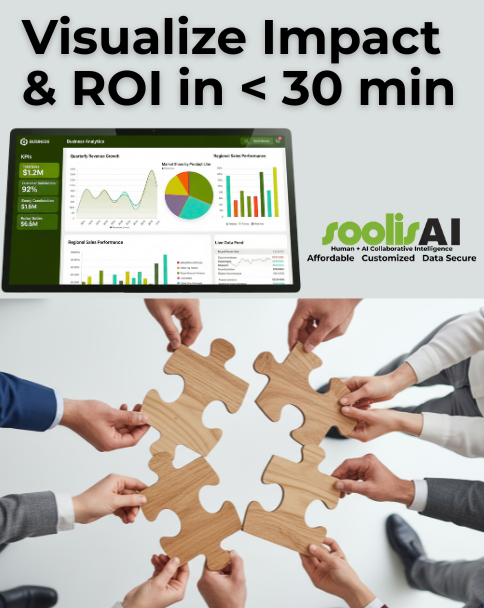
We value your time. Visualize the possibilities < 30 min!