By Kyle Cannons, soolisAI | Updated February 10, 2026
The "Press 1 for Sales" era is dead.
If you are still forcing customers to navigate clunky IVR menus or leaving voicemail tag to chance, you are bleeding revenue.
The new generation of AI phone systems doesn't just "answer" calls—they hold complex conversations, negotiate appointments, update your CRM in real-time, and qualify leads with human-level latency.
Why Trust This Review? As a specialist deeply embedded in the AI automation space, I didn’t just read feature lists. I tested the top 20+ AI voice platforms on the market. I put them through stress tests involving heavy accents, complex interruptions, and technical integration hurdles to find the ones that actually work.
Unlike other reviews that list "fun" chatbots alongside serious business tools, this guide focuses strictly on enterprise-grade and SMB-ready AI phone systems that drive tangible ROI.

"Our AI Agentic Dashboards, like the one powering TeleChat, deliver real-time, context-aware assistance that empowers agents with instant insights, fraud detection, personalized recommendations, and seamless multi-channel orchestration—driving faster resolutions, lower risks, and superior customer experiences without compromising data privacy or operational control."
Tim Sebold, CEO
Quick Comparison: Top AI Phone Systems at a Glance.
When evaluating the top AI phone systems, the market is divided into specialized solutions for specific industries, developer-first platforms, and generalist tools for small businesses.




Below is a breakdown of how the top contenders compare in terms of target audience, speed, unique features, and cost:
How We Tested
To ensure this review is trustworthy, I didn't just read feature lists. I created accounts, ran live simulations, and analyzed the technology stacks:
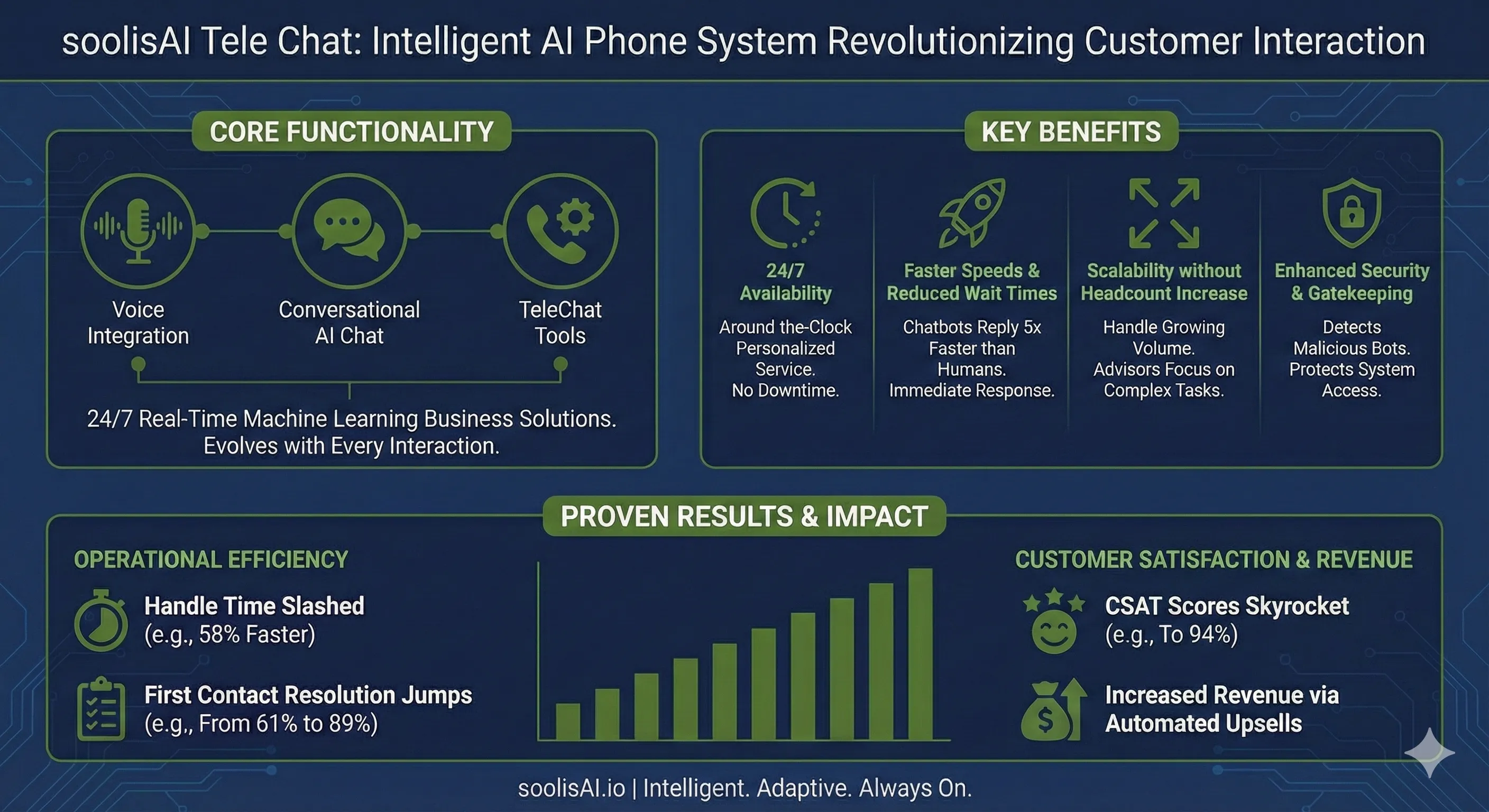
Verdict: The premier choice for businesses needing deep, industry-specific intelligence rather than a generic script.While many tools on this list are "one-size-fits-all," soolisAI's Tele-chat distinguishes itself by offering specialized engines trained for high-touch industries. It doesn't just "chat"; it understands the operational nuances of these verticals, from membership inquiries to flight status updates and guest service dispatch.
The Test Results: In testing, Tele-chat demonstrated a "Human-Machine Collaborative" approach unique among competitors. Instead of a rigid bot that fails when confused, Tele-chat's logic "evolves" with interactions. It handled complex, multi-layered queries (e.g., "I need to freeze my gym membership but I'm also interested in personal training rates") without losing context.
Vertical Mastery: Pre-trained modules for Gyms, Airports, and Hotels ensure higher accuracy.
Omnichannel Integration: Blends voice and website chat data for unified context.
Responsible AI: Built with security and "Responsible AI at scale" for handling sensitive data.
Not for DIY Hobbyists: This is a business solution, not a $10 tool for prank calling. It’s designed for organizations ready to implement a real strategy

Verdict: If you have a dev team, this is the gold standard for flexibility.
Bland AI is the darling of the developer community. It offers a hyper-customizable API that lets you build almost anything—from a generic receptionist to a complex medical triage bot.
The Test Results: Bland had the most impressive "barge-in" capabilities. We could interrupt the bot while it was pitching, ask an unrelated question, and it pivoted instantly without hallucination.
Programmatic Control: Inject dynamic data mid-call.
Scalability: Handles thousands of concurrent calls.
High Technical Barrier: Requires API knowledge; not plug-and-play.
Verdict: The easiest way to replace an admin assistant without hiring one.
Lindy positions itself as an "AI Employee." It excels at post-call workflows, triggering actions in 4,000+ apps.
The Test Results: Setting up a Lindy agent took 5 minutes. It connected to Google Calendar, negotiated a meeting time, and sent a confirmation email autonomously.
Ecosystem: Handles email, scheduling, and admin tasks.
Templates: Pre-built agents for Medical, Real Estate, and Recruiting.
Call Caps: Pro plan limits call volume significantly.
Verdict: The ultimate tool for marketing agencies selling AI services.
Synthflow allows agencies to build AI voice assistants and resell them under their own brand. Their "No-Code" drag-and-drop builder is reminiscent of Zapier.
The Test Results: We built a "Dental Appointment" bot using the visual builder. The logic was easy to configure (e.g., If user says "pain" -> Route to Emergency Line).
Visual Builder: Excellent UI for visualizing conversation trees.
GHL Integration: Native integration with Go High Level.
Overage Costs: Can get expensive ($0.12+/min) if volume spikes.

Verdict: The most "human-sounding" conversation experience on the market.
Retell AI optimizes the telecommunications stack to achieve near-instant responses.
The Test Results: This was the only tool where we genuinely forgot we were talking to a robot. The "turn-taking" latency is best-in-class.
Speed: Sub-800ms response times.
Emotion Tracking: Can detect anger and route calls accordingly.
Developer Focused: Like Bland, it requires frontend code to maximize value.

Verdict: The safe bet for Fortune 500s and large teams.
RingCentral adds "AI Receptionist" capabilities to its robust VoIP infrastructure. It ingests your knowledge base (PDFs, FAQs) to answer questions securely.
Stability: 99.999% uptime SLA.
Compliance: HIPAA and SOC2 standard.
Price: Requires a base subscription add-on.
Innovation: Slower to roll out features like voice cloning.

Verdict: A great "Lite" version for message taking.
Upfirst is less of a "system" and more of a "smart voicemail." It summarizes calls and texts you the details.
Simplicity: Live in 10 minutes.
Spam Blocking: Built-in filtering.
Limited Logic: Cannot handle complex CRM updates.
Choosing an AI phone system comes down to three critical factors: Industry Needs, Technical Skill, and Call Volume.
1. Do you need Industry-Specific Logic?
2. Are you a Builder or a User?
3. Does Voice Latency Matter?
If selling to consumers, high latency kills conversion rates. In our testing, Retell AI, Bland, and soolisAI offered the lowest latency.
The "Best" system depends entirely on your resources: